18 December 2018

William Morris and Kehinde Wiley


After Kehinde Wiley’s portrait of Barack Obama was unveiled at the National Gallery of Art in Washington, D.C. in 2017, the already-successful artist received unprecedented attention. And, in a roundabout way, Kehinde Wiley’s success is also bringing more attention to the designs and general aesthetic of William Morris. This fall, in the first Wiley exhibition since the unveiling of the Obama portrait last year, eleven portraits of Saint Louis citizens are already drawing commentary in the news that the background designs of the portraits evoke the wallpapers designed and manufactured by William Morris. This new show, Kehinde Wiley: Saint Louis, will be held at the Saint Louis Art Museum from October 19, 2018 until February 19, 2019.

Some of the references to William Morris wallpapers are more overt than others. The portrait "Robert Hay Drummond, D.D. Archbishop of York and Chancellor of the Order of the Garter" (2018) clearly uses motifs of the ogee tree and pomegranate that distinctly appear in the Granada wallpaper design (1884). Other references are more oblique: the painting “Tired Mercury” evokes the general dynamism of William Morris design and the distinctive whorls of flowers seem reminiscent of the Pimpernel wallpaper (1876).


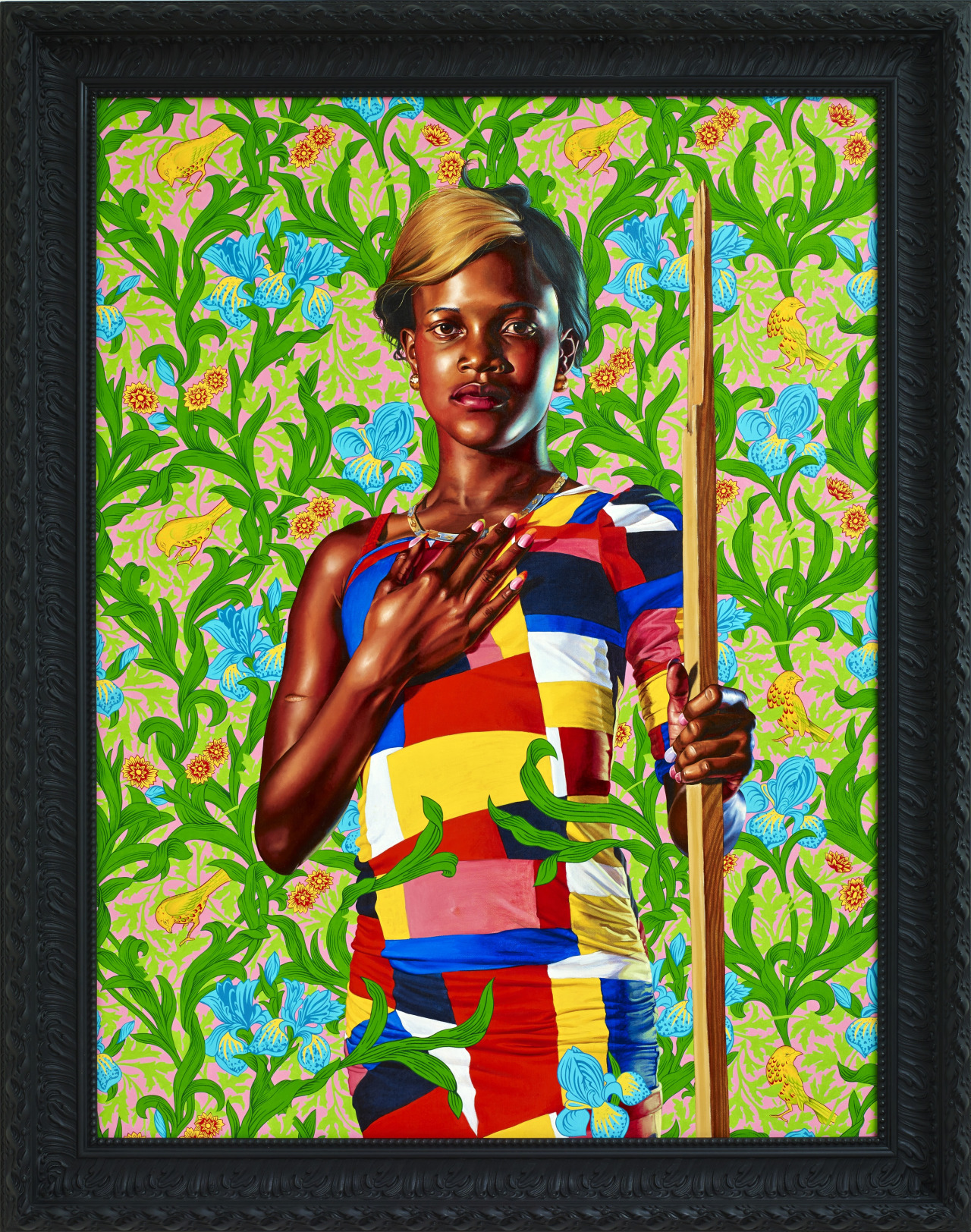
These Saint Louis paintings are not the first time that Kehinde Wiley has looked to William Morris for inspiration. A few years ago, the exhibition Kehinde Wiley: A New Republic appeared at the Brooklyn Museum of Art (in 2015) and Seattle Art Museum (in 2016) which included paintings with references to Morris and his manufacturing group Morris & Co. For example, the background design in Saint John the Baptist in the Wilderness is inspired by the “Iris” wallpaper (c. 1887) designed by J. H Dearle for Morris & Co. Another painting from the show, “Mrs. Siddons from the series ‘The Economy of Grace,’” (2012) includes a background that copies the design of the Blackthorn block-printed wallpaper that Morris designed in 1882.
"Mrs. Siddons from the series 'The Economy of Grace'" and detail image of Blackthorn-inspired wallpaper
Photographs by author
Unfortunately, the exhibition panels of Kehinde Wiley: A New Republic didn’t explore these connections with Morris very well, and the labels of the current show at the Saint Louis Art Museum also don’t mention Morris specifically, but connect the background prints to “international markets of textile production.”[1] I find this disappointing, and my sentiments are echoed in a published review of Brooklyn Museum of Art show which suggested that mentioning the origins of the backgrounds in Wiley’s paintings would strengthen the show.

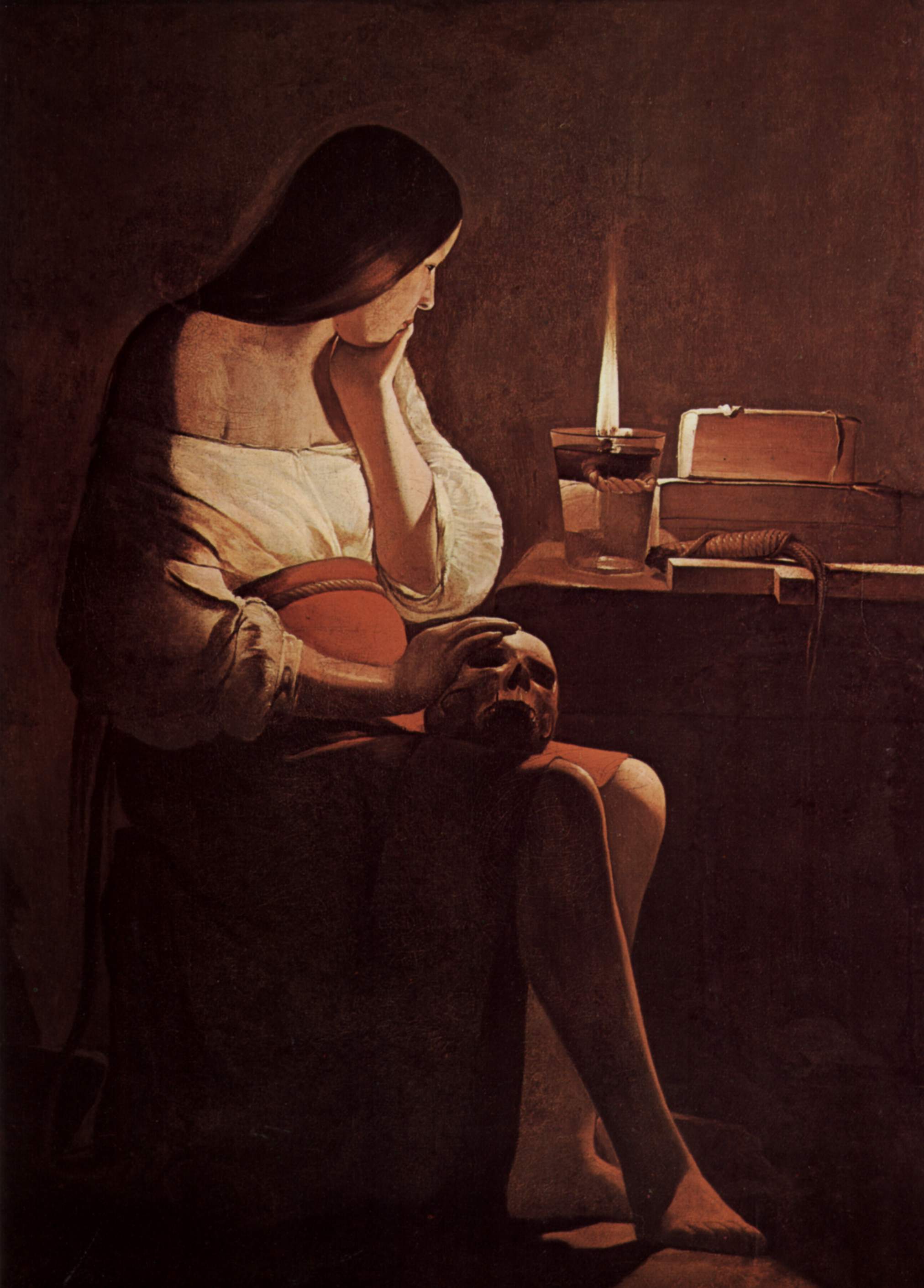
It seems like there are several reasons for why Kehinde Wiley chooses to reference William Morris’s designs in some of his paintings. On one hand, Wiley’s compositions and designs are trying to draw awareness to the realm of history and art history, not only with the decorative motifs but the way the figure is represented (the female figure’s position in “Mrs. Siddons” turns looks away from the viewer in a way which reminds me of depictions of the penitent Magdalene by George de la Tour).
In past centuries, fine art was typically associated with white Europeans and refinement. Wiley wants to challenge the idea that fine art and statements of cultural refinement are limited to a specific race; he does this by referencing European artistic traditions in his portraits of black people. To help emphasize his point, Wiley draws inspiration from Morris’s wallpaper designs, since they are associated with taste and the high-quality production surrounding the Arts & Crafts movement. In the exhibition catalog for Kehinde Wiley: A New Republic, Annie Paul explains that Wiley creates “decorative backgrounds [which are] inspired by the English designer William Morris, who wove images from botany and zoology into intricate patterns signifying taste and discrimination.”[2] It seems like Wiley occasionally uses Morris’s designs to reference English history and colonialism, too. For example, the inclusion of a Morris print in St. John the Baptist in the Wilderness references the past colonial presence of the English in Jamaica.
So, Kehinde Wiley’s portraits of black figures, which contain visual references to European history and European art, call for attention and help to create a new vision of contemporary black identity and presence. Holland Cotter, in reviewing a 2005 exhibition of Wiley’s work, asserted as much by saying that Wiley “is a history painter. . . . By this I mean that he creates history as much as tells it.”[3] And what would William Morris think about his imagery being utilized in this way? I think that he would be quite pleased: Morris was a socialist who wanted to bring about a change in the art world and society. William Morris felt like the arts, particularly the decorative arts, “were ‘sick’ as a consequence of the split between intellectual and mechanical work that occurred during the Renaissance.”[4] Perhaps in a similar vein, Kehinde Wiley seeks to bind together racial divides and “heal” stereotypical assumptions about what constitutes art and portraiture.
So when Wiley’s paintings are considered in terms of social unity, Morris’s designs are very appropriate. Art historian Caroline Arscott has analyzed Morris’s designs in relation to the social climate of his day, finding that the designs “imagine an overcoming of social contradictions in an allegory performed ‘through the twists and turns of plants.’ In this way his aesthetic stands as a powerful equivalent for the recovered wholeness of men and women, of their relations to their fellows and to nature.”[5] In many ways, Wiley is also suggesting similar themes of “wholeness” by binding different cultures together within his paintings. It isn’t surprising, then, that Wiley is inspired by designs of plants which repeatedly interconnect, wind, and bind themselves to each other. And it is even more appropriate, then, that the Saint Louis Art Museum is not charging admission for entrance to the current Wiley exhibition, so that the accessible venue can serve as a way to bring the community together.
- Monica Bowen, Seattle University
An earlier version of this post was written in 2016: http://albertis-window.com/2016/02/kehinde-wiley-and-william-morris/


[1] Wall text, Kehinde Wiley: Saint Louis, Saint Louis Art Museum, Saint Louis, Missouri
[2] Holland Cotter, “Art in Review: Kehinde Wiley,” New York Times, December 9, 2005. 
[3] Eugenie Tsai, ed., Kehinde Wiley: A New Republic (New York: Brooklyn Museum, 2015), 146. 
[4] Steve Edwards, “Victorian Britain: From Images of Modernity to the Modernity of Images,” in Art and Visual Culture 1850-2010 by Steve Edwards and Paul Wood, eds. (London: Tate Publishing 2012), p. 81.
[5] Ibid., 81.

23 October 2018

An Afternoon with Lord Tom Sawyer


It was a delight to meet the new President of the UK William Morris Society during a recent visit to London.  Lord Sawyer of Darlington (Tom Sawyer) is the new President as of May 12,, 2018.   The press release announcing Lord Sawyer’s presidency outlines his impressive career and longstanding interest in William Morris:
"Lord Tom Sawyer Standing in front of the House of Lords,"
http://www.designerbookbinders.org.uk/exhib/past_exhibitions/past_exhibitions.html

Tom Sawyer began his working life at the age of 15 on the factory floor of a County Durham engineering works. He went on to have a distinguished career in the labour movement, including serving as deputy general secretary of NUPE [National Union of Public Employees] and later UNISON [one of the UK’s largest trade unions], before becoming General Secretary of the Labour Party from 1994-98. He recently stepped down as Chancellor of Teeside University after serving a twelve-year term.

Tom first encountered William Morris’s writing at the age of 21, when he read Morris’ classic Utopian work News from Nowhere. He says of his relationship with Morris:

‘Throughout my years as a union official I would often turn to Morris for inspiration and incorporate ideas from his work, particularly signs of change, into my speeches…His message and his principles are timeless. He has enriched many lives – mine included.’

            (retrieved from https://williammorrissociety.org/2018/03/15/a-new-president-for-the-society/, August 6, 2018) 

The meeting with Lord Sawyer was made all the more exceptional because it included a personal tour for me and my daughter of the Houses of Parliament, as designed by Charles Barry with interiors by Augustus Pugin.  The two Houses, the House of Commons and the House of Lords, differ significantly in style.  The House of Lords is very grand and opulent while the House of Commons is more understated in keeping with the population it represents.  We were treated to a visit to the Queen’s Robing Room, the Royal Gallery, both the Lords and Commons Chambers, as well as the House of Lords Library, which features a series of riverside rooms with wonderful views of the Thames.  Along the way we learned a few behind-the-scenes facts including, for example, that each Lord has a special locker and peg for their robes.  It was evident as we toured the House of Commons that Lord Sawyer is a highly esteemed Peer.  It certainly bodes well for the William Morris Society, which will benefit from having such a well-respected and genuinely interested leader.

Lord Sawyer is an avid book collector who has devoted time and energy to building up a fine collection of books on socialism.  He documented his collection in a book published in 2012, Radicalism, A Passion for Books.  

As he shares in the Introduction:   

Book collecting is a very private affair; books slip on and off shelves and in and out of houses, most often unseen and unknown by any person other than the book collection.  Very few collectors have left a record of why they chose particular books. So I decided I would leave a short story that others, including my family and friends, but particularly my grandchildren might enjoy or at least understand the reasons for my passion. (x)

The book is divided into thirty-one sections, showcasing a wide range of topics, with the twenty-third section devoted to William Morris. Of Morris, Sawyer writes, “Morris is the man.  The greatest ever British Socialist.  Morris the writer, Morris the agitator, Morris the thinker, Morris the activist” (91). His collection of Morris materials is incredibly diverse and includes published books, pamphlets and ephemera, along with items from the collection of Arthur Halcrow Verstage, an architect with a lifelong love of William Morris and a founding member of the UK William Morris Society.  Some of treasures in this collection include a letter from May Morris to Agnes Larkin (eldest daughter to Dr. Robert Steele, a well-known scholar and friend of Morris), a photograph of May in old age at Kelmscott House, a proof copy of The Sundering Flood, and numerous pamphlets published by the Socialist League and the Hammersmith Socialist Society.

Lord Sawyer also has a particular interest in the art and craft of bookbinding. In 2008 he commissioned a number of designer bindings of seminal texts in the history of British socialism, including Morris’s News from Nowhere, for an exhibition which he organized at the House of Lords.  He worked closely with the Designer Bookbinders of the United Kingdom, a long-established society devoted to the craft of fine bookbinding and commissioned unique and beautiful bindings that celebrated their craft and creativity as well as the history of socialism in Britain. Master bookbinder Lester Capon bound News from Nowhere.  Capon studied at the Camberwell School of Arts and Crafts and has been a Fellow of Designer Bookbinders since 1986.  His work is represented in libraries across the United Kingdom and United States.  As described in the catalogue, 

The theme is taken from Morris’ trip up the Thames during which he experiences and portrays his vision for the future.  The layout is based on the format of journey maps that were prevalent in the 19th century.  The gold work and colored underlays running across the book represent his vision. I felt it suitable to use vellum for this binding as Morris often used it for the Kelmscott Press.  Also the ‘pierced vellum’ technique is an early style of binding here revived and adapted – I hope Morris would have approved. (17)  


News from Nowhere, binding by Lester Capon
(Catalogue 16)
News from Nowhere was an important book and, as shared by Lord Sawyer, 

Many people consider it to be Morris’s best work and that great as he was, he was greatest as a revolutionary.  I feel certain that News from Nowhere was read extensively by the early socialist activists. Although it did not feature in a list of books read by the intake of Labour members of Parliament in 1906, it was included as recommended reading by Robert Blatchford at the end of his book, Merrie England. (16)

Also included in the 2008 exhibition was William Morris – Artist Writer Socialist by May Morris, as bound by Stephen Conway.  Conway currently runs a small bindery in Halifax, West Yorkshire, working mainly on private press editions, presentation work, commissions and design binding. In 1998 he won the Designer Bookbinders Silver medal and in 2000 was elected Fellow of Designer Bookbinders.  The book was selected as part of the exhibition as an homage to William Morris.  Volume 1 is focused on Morris’s artistic and literary output, while Volume 2 focuses on Morris as a socialist and is supplemented by an essay by George Bernard Shaw.  Conway’s new binding depicts a stained-glass window and is loosely based on a Morris window designed for Bradford Cathedral.  An image of Morris is found on one of the panels and the overall design reflects his interest in the medieval.  

William Morris by May Morris, binding by Stephen Conway
(Catalogue 38, 39)

The legacy of William Morris is made all the stronger by the committed leadership of Lord Tom Sawyer.  The William Morris Society U.S. congratulates him on his appointment as President of the Society and looks forward to years of collaboration.

~~Jane Carlin, University of Puget Sound

Call for Applications - 2019 Joseph R. Dunlap Memorial Fellowship


The William Morris Society in the United States is calling for applications for the 2019 Joseph R. Dunlap Memorial Fellowship. The deadline is December 15, 2018. Applications are judged by committee, and the decision will be announced by January 15, 2019.
The Dunlap Fellowship supports scholarly and creative work about William Morris.  The fellowship offers funding of $1000 or more for research and other expenses, including travel to conferences and libraries. Projects may deal with any subject—biographical, literary, historical, social, artistic, political, typographical—relating to Morris. The Society also encourages translations of Morris's works and the production of teaching materials (lesson plans and course materials) suitable for use at the elementary, secondary, college, or adult-education level. Applications are sought particularly from younger members of the Society and from those at the beginning of their careers. Recipients may be from any country and need not have an academic or institutional appointment, nor must recipients hold the Ph.D. Although recipients are not required to be members of the William Morris Society, we encourage those applying to join and to share in the benefits of membership.
In some years the Society offers a second, smaller fellowship, the William Morris Society Award (the amount to be determined by the committee of judges).  The purpose and aims of this second award are the same as for the Dunlap Fellowship.
Applicants should send a two-page description of their projects, along with a c.v. and at least one letter of recommendation. For a translation project, please submit an additional letter from a recognized authority able to certify the applicant's competence in both languages. For teaching materials, we ask also for a cover letter describing the ways in which the materials might be used in learning situations. The Society would be pleased to publish any completed translation or teaching materials on its website, but this is not a requirement.
Send applications by email (with the subject line “Application for the Dunlap Award”) to:
Paul Acker, Saint Louis University | President, WMS-US: paul.acker@slu.edu
and
Jane Carlin, University of Puget Sound| Secretary, WMS-US: jcarlin@pugetsound.edu

For more information, see the Morris Society website.