14 June 2014

How About a Morris Memorial Walk? A Modest Proposal


A Rainbow over Kelmscott Manor: photo by John Plotz


Back in 2011, I was lucky enough to spend ten days in and around Kelmscott, Oxfordshire. It couldn’t have been a better trip. When I wasn’t at the Manor itself, I visited the Great Tithe Barn at Coxwell, various churches that Morris worked on (Eaton Hastings ) or simply admired (St Mary’s in Castle Eaton), rowed (feebly) under the sweeping willows that Morris loved so much. On the last day I even saw a rainbow over Kelmscott Manor.

Although I’m not a macabre person, I was pleased to be there both on the anniversary of Morris’s death (October 3) and his burial three days later (October 6, 1896, a dark cold day). I’d been spending a lot of time at the gorgeous parish church of St. George’s, puzzling out the medieval wall paintings and admiring Webb’s memorable inverted-ship tombstone for William, Jane, Jenny and May Morris. So naturally I wonder what kind of commemoration to expect. Would it be Fabians, Guild Socialists, loyal Marxists? Or would his Arts and Crafts acolytes have set the tone? The answer was simple: none of the above.

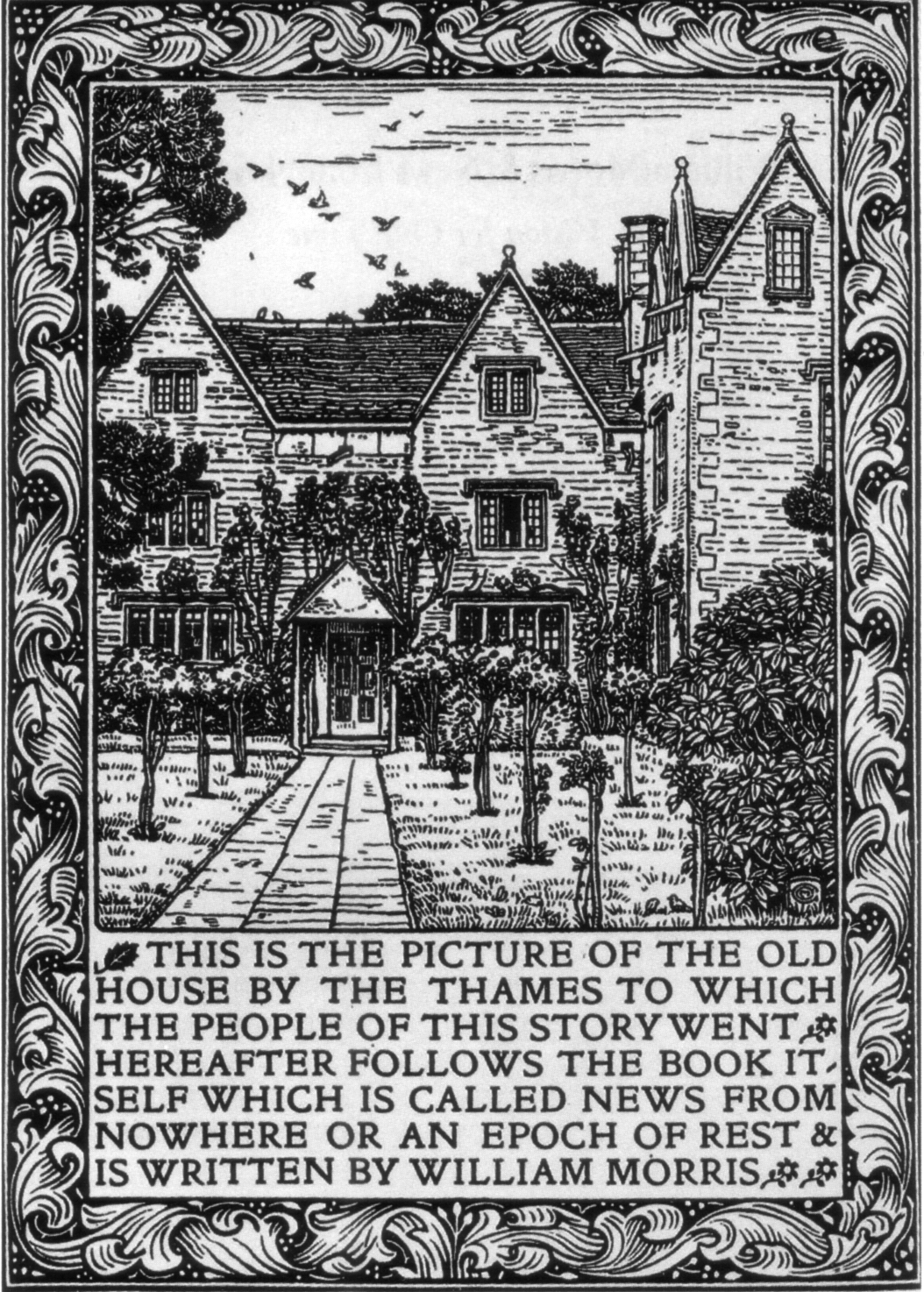
It seemed wrong that so little should be done to mark a crucial moment in the Morris calendar at a crucial place, the “old house by the Thames to which the people of this story went.” So I had an idea, more or less the same one that John Paynes turned into his lovely book, Journey up the Thames.

Why not undertake the trip taken not only by Morris’s corpse after his death, but also by Guest, Clara and their companions in News from Nowhere? It seems a voyage that has as much to do with Morris’s life as with his death.

So, here’s my thought. Morrisites of all stripes should come together to follow the straightforward route marked out by the Thames Path and make a kind of Morris pilgrimage, arriving at Kelmscott Manor on October 6th. Although I realize that early October is an awful fit with the American academic calendar, I can at least attest to the mildness of the weather then. The ambitious could devote ten days to undertaking the 150 miles from London, while the more modest could (like me, on an unexpectedly balmy weekend) hoof just the final 50 miles from Oxford. Although the train no longer comes within a couple of miles of Kelmscott as it did in Morris’s day, boating wouldn’t out of the question. And anybody who elected to arrive by car would at the very least meet up with the party at Morris’s tomb on October 6th.


I admit the scene won’t be as tumultuous as that October day in 1934 when Prime Minister Ramsay McDonald missed George Bernard Shaw’s speech, and the dedication of Morris Memorial Hall on account of the crowds that flooded into Kelmscott. Still, is any one else as charmed as I am by the prospect of a walking, talking, disputating crowd of Morrisites, making their way argumentatively and amicably up the Thames?    

--John Plotz, Professor of English at Brandeis University

31 March 2014

William Morris’s Legacy in the 20th-Century Avant Garde


Lorine Niedecker, via the Poetry Foundation
Listening to a recent talk on ecology and contemporary poetry given by Professor Margaret Ronda, I was struck by how closely the aesthetic and political concerns of Objectivist poet Lorine Niedecker mirror those of William Morris, who was writing 75-100 years earlier. Niedecker’s work evinces a discomfort with the new, with aesthetic and literary emphases on innovation, and connects such neophilia with an unsustainable capitalist ideology of disposability and overproduction. This same anxiety about the connection between capitalist production and an aesthetic preference for innovation is apparent in Morris’s work, as I mentioned to Ronda after her talk. Imagine my surprise when Ronda told me that Niedecker was deeply interested in Morris and had in fact written a poem about him, titled “His Carpets Flowered.”

The poem, reprinted below, was written in the late ‘60s, and it suggests that Niedecker was primarily inspired not by Morris’s poetry, nor by his work in arts and crafts, but by his letters, and more specifically, by Morris the man as expressed in his letters. As Niedecker wrote in a 1969 letter to fellow poet Cid Corman: “I'm absorbed in writing poems--sequence--on William Morris. I know how to evaluate--Ruskin, etc., their kind of socialism--paternalism--but the letters of William Morris have thrown me. Title will be His Carpets Flowered. I can't read his poems. I'd probably weary of all those flowery designs in carpets, wall papers, chintzes...but as a man, as a poet speaking to his daughters and wife--o lovely” (455).

28 March 2014

The Teaching Morris Initiative


The William Morris Society in the United States is pleased to announce its new "Teaching Morris" initiative.

As part of this effort, the governing body of the WMS has approved the creation of a "Teaching Morris" advisory board. The advisory board will consist of five members, with no more than two from the governing board.

Governing board members Jane Carlin and Jason Martinek are spearheading this effort. We're looking not only to provide a clearinghouse for teaching materials already available about William Morris and his circle, but also to encourage the preparation of new materials. Our goal is to have resources for K-12 teachers as well as college and university professors. We also want to find a conference venue to share and showcase innovative approaches to teaching Morris that will engage and help foster a new generation of Morris scholars.

We are looking for nominations for the advisory board. If you are interested in self-nominating please email Jason at jmartinek@njcu.edu or Jane at jcarlin@pugetsound.edu. As part of the self-nomination please include a short paragraph introducing yourself and another expressing an idea or two about promoting Morris's life and legacy. We'd like to form the advisory board by the end of April. Please get your self-nominations in by 20 April 2014.

Feel free to contact Jason or Jane with your questions.

08 March 2014

MLA 2014: Morris and Arts and Crafts in the Midwest


St. Margaret: One of two Edward Burne-Jones windows in the Second Presbyterian Church.
(Photo courtesy of Yooperann on Flickr.)

 Chicago was cold and wet, with snow and slush everywhere. Instead of sidewalks there were slidewalks. Was it the plan of the MLA convention organizers to pick a location that kept people indoors? If it was, it didn't work for the tried and true members of the William Morris Society. Wherever there is Morrisiana in an MLA city, you are sure to find a group willing to brave treacherous conditions to bask in the glory of arts-and-crafts architecture, design, and stained-glass. I was proud to count myself among them, slipping and sliding all the way.

08 February 2014

Morris and 20th Century Vienna

Before 2013 is a distant memory, I want to rescue an item from the 22 February 2013 issue of the  Times Literary Supplement(pp. 7-8) that made interesting mention of Morris. The article in question might have been passed over by many Morrisians, for it was Edward Timms's review of Wer Einmal War: Das jüdische Grossbürgertum Wiens 1800-1938 by Georg Gaugusch, a fascinating reference work on the affluent Jewish families of Vienna prior to World War II. Timms points out that whereas clubs were the crucial meeting place for nineteenth-century intellectuals and influential writers in London, the meetings of artists and intellectuals took place in Vienna in the more egalitarian environment of coffee houses. And he adds the following:

“It was around those coffeehouse tables that the two most successful artistic enterprises of turn-of-the-century Vienna were created. Early in 1903, the architect Josef Hoffmann was sitting with the designer Koloman Moser in the Cafe Hermannshof opposite the Opera, discussing the creation of applied arts workshops similar to those of the English Arts and Crafts movement. There they were joined by Felix Wärndorfer, a Jewish businessman with a passion for the work of William Morris. When he heard about their project he reportedly slapped 500 kronen down on the table - and the Wiener Werkstätte was born. It proved so successful that in its heyday it had retail outlets in Berlin and New York, as well as Vienna” (p. 8).

So as we begin 2014, we can think appreciatively of Morris’s connection to Jewish Vienna at the beginning of the twentieth century, of his global reach, and of Morris’s essential role in the founding of the  Wiener Werkstätte, which in manufacturing furniture, household items, jewellery and so on represented a twentieth-century afterlife of Morris and Co.

—Linda K. Hughes

(Image courtesy of the Wikimedia Commons)

11 January 2014

A Special Viewing of Morris's Famed Albion Press

Jethro Lieberman with the Albion press. Photo by Marilynn K. Yee for the New York Times.

Last month, about 35 people came to the special viewing of William Morris's Albion press at Christie's in New York. The group included members of the Morris Society, the Grolier Club, and the American Printing History Association. The viewing included a talk by longtime owner of the press, Jethro Lieberman. 

Lieberman inherited the press from his parents, J. Ben and Elizabeth Lieberman. In recounting the press's presence in his family for over a half century, Lieberman recalled the surprise appearance of a New York Times reporter soon after the press came to their New Rochelle home in 1961. His parents were not at home so the reporter took a picture of the 17-year-old Jethro standing next to the Albion in coat and tie. (This photo was reproduced in the NYT article on the auction last month as well.)

Lieberman also told of occasions on which visitors were invited to set their own name in type and print a personal keepsake. In describing his decision to sell the press, he said he wished it to be put to work, rather than to remain a static icon of William Morris. Indeed his father, a journalist, printer and one of the founders of the American Printing History Association, had refused offers from institutions wanting to purchase the press for display purposes.

The press sold the next day for $233,000 by Bromer Booksellers, of Boston, acting on behalf of an unnamed client "who will put it to good use." The client, it was later revealed, was the Cary Graphic Arts Collection at the Rochester Institute of Technology.

Steven Galbraith, curator of the collection, assured fans of the press that it would not simply be put on display: 

“The Kelmscott/Goudy Press will have an active life at RIT, not simply as a museum artefact, but as a working press accessible to students, scholars and printers... I’m certain that the Kelmscott/Goudy Press will be a great inspiration to students at RIT and to others who visit our library’s pressroom.” 


21 November 2013

The Killer Wallpaper that Never Was

Morris's Pimpernel wallpaper design, registered 1876.
During the 1860s, a press campaign began in Britain to raise awareness concerning what were then believed to be the ‘dangers’ of arsenic in wallpaper. By 1883, the well-known design firm Morris & Co. bowed to public opinion, and all their wallpapers became free from arsenic, despite the fact that Morris thought (rightly so, as it turns out) that the scare was groundless.

Today, two popular accusations are still levelled at William Morris, both loosely related to the arsenic scare: that given his Socialism his directorship of the Devon Great Consols mine (a major source of arsenic) was hypocritical, and that his use of arsenical pigments in wallpapers was an act of mass poisoning owing to the supposed formation of toxic gases (TMAs) by these materials.

Patrick O’Sullivan, editor of the Journal of William Morris Studies, has addressed these criticisms in a forthcoming paper in the Reports and Transactions of the Devon Association for the Advancement of the Arts and Sciences: ‘Devon Great Consols and William Morris’. The first is easy to repudiate: Morris relinquished all interest in Devon Great Consols (and ceremoniously sat on his director’s top hat) seven years before becoming a socialist. He did however, before that time, “clearly share in the collective culpability of all mine owners, directors and shareholders of the period for the truly appalling working conditions (at the mine) ... ”.

As the new paper highlights, the second accusation is also fundamentally flawed.  An earlier paper on the subject of arsenical wallpapers, ‘The toxicity of trimethylarsine: an urban myth', by William R. Cullen and Ronald Bentley, (Journal of Environmental Monitoring, 7 (1): DOI: 10.1039/B413752N) states that although TMAs may form in very small quantities under specific conditions—but which are not present in arsenical wallpapers—the gas has “very low toxicity.” They conclude: “It appears to us most likely that TMAs is not and never was a silent poison or killer .… It seems a pity that we should now have to abandon this fascinating urban legend (our italics).”

Throughout his life, Morris remained unconvinced about the alleged dangers of arsenic in wallpapers. In 1885, the year his own wallpapers finally became arsenic free, he wrote to his friend and fellow businessman Thomas Wardle, who had taught Morris about commercial textile bleaching and dyeing. 
As to the arsenic scare a greater folly it is hardly possible to imagine: the doctors were bitten as people were bitten by the witch fever. … My belief about it all is that doctors find their patients ailing don't know what's the matter with them, and in despair put it down to the wall papers when they probably ought to put it down to the water closet, which I believe to be the source of all illness. And by the by as Nicholson is a tea-totaller he probably imbibes more sewage than other people: though you mustn't tell him I said so.
The arsenic produced by Devon Great Consols, and many other mines in SW England, was used in more than just wallpapers, and certainly caused serious harm, both at the point of mining, and in the form of some consumer products. But it must be remembered that Morris resigned from the board of that company in 1875, eight years before he took up socialism.

In one sense, Morris's subsequent career can be seen as an effort to leach the poison back out of the world: ‘Devon Great Consols and William Morris’ argues that Morris's connection to the mine positively influenced his views on environmental issues, feeding his vision for an ecological society as expressed in his romance novel News from Nowhere (1891). The paper, which also addresses a much broader set of issues than discussed here, is forthcoming. We will announce its release at a later date.